Tuesday, September 30, 2025

Besides Light Rail Where Does The Proposed Charlotte's Sales Tax Increase Money Grab Go?

Roads 40% of all new tax revenue must be spent on them, in addition to the 40% that can be spent on adding rail lines and 20% for buses.

That’s about $8 billion for roads over 30 years. It’s a crucial part of an estimated $25 billion transit and transportation plan. 

In November, voters will weigh in on whether to support the plan by raising Mecklenburg’s sales tax from 7.25% to 8.25%. That increase would cost the typical household an additional $240 a year, the city estimates. But in reality it is likely to have a far greater impact on Charlotte residents.

Unlike the money for rail and buses, which would go to a new 27-member authority that would work out the details, the road money would flow to the city of Charlotte and to Mecklenburg’s six towns, who would decide how it is spent.

No surprise the money would be doled out using a complex formula. The city of Charlotte expects to receive about $100 million a year. Mecklenburg’s six towns have estimated that they will receive somewhere between about $2 million and $12 million a year.

While the money is referred to in shorthand as “road money,” it doesn’t actually have to be spent on building or expanding roads with more lanes for cars. Under the legislation, the municipalities can use it for “costs associated with financing, constructing, operating or maintaining roadway systems.”

In other words, you may never see any improvement in Charlotte's roads because the city could use every dime to pay interest on bonds.

But the blueprint offered by the City of Charlotte gives an indication of what kind of projects the city wants to build.

  • The words “bike” or “bicycle” appear in the blueprint 835 times.

  • The words “pedestrian” or “sidewalk” are mentioned 709 times.

  • The term “Shared Use Path” is mentioned 241 times.

The city of Charlotte’s plan for spending “road money” includes a lot of projects that would make biking easier. (Photo from the city’s “Blueprint for Charlotte Mobility Investment.”)

As for traditional road projects:

  • The words “new street” are mentioned 25 times.

  • “Vehicular capacity” shows up 16 times, and “road capacity” is mentioned once.

  • “Travel lanes” appears 36 times, though most are qualified as being potential projects — not something that is guaranteed to be built.

  • “Traffic signal” is mentioned 58 times.

  • “Intersection improvements” are listed 123 times, though the blueprint is light on the details. Most are listed as “Scope TBD.” It’s unclear if that means new turn lanes or longer turn lanes.

  • “Turn lanes” appears in the document two times.


At this point you likely get the picture. First a bunch of those arrogant bicycle clowns had a serious impact on the road money "blue print". Second as for wider roads and more effective traffic signals forget it.

Any way you look at it Taxation is Theft. 

The city of Charlotte will decide how to spend this increase in your tax burden and Charlotte will have the highest sales tax rate in the Carolinas. 

Tuesday, September 23, 2025

Charlotte Lynx Blue Line Rider

Charlotte Lynx Blue Line rider tells of her personal experience with homeless people riding the light rail line for free. She asks why is this allowed if Charlotte needs to raise the county sales tax to pay for the Light Rail Line.


Susan Rodriguez-McDowell “The Whole Story on the Transit Tax.” Meeting October 9th at 6:00 PM

As Mecklenburg County gears up for a vote on a proposed one-percent sales tax increase, some residents are wondering if safety concerns, like the recent deadly stabbing on Charlotte’s light rail, might influence the outcome.

The tax proposal, which will appear on the November 4 ballot, is expected to raise about $19 million each year over the next 30 years.

The money would go toward transportation projects across the region.

To help voters make an informed decision, County Commissioner Susan Rodriguez-McDowell is hosting two community meetings called, “The Whole Story on the Transit Tax.”

These sessions are open to everyone, whether you support the tax, oppose it, or just have questions. CATS officials will explain how the additional funding would be used.


The first meeting will be held on Thursday September 25, 2025 evening at Christ the King Church on S. Tryon Street. The second meeting will be held on Oct. 9 at Matthews Town Hall on Matthews Station St. at 6:00 PM Please register to attend here.

The meetings will also include a panel featuring community voices from all sides of the debate. City leaders, including Council Members Marjorie Molina and Ed Driggs, have already held similar info sessions to encourage public discussion.

As the November vote approaches, public safety, transportation needs, and how tax dollars are spent will all be key parts of the conversation.

Saturday, September 20, 2025

Charlotte City Council Member Ed Driggs 180 on Tax Increase

Veteran Reporter Steve Harrison explores Charlotte's transportation sales tax increase and asks why has Ed Driggs become a tax increase cheerleader?

Follow Steve Harrison on  "X" @Sharrison_WFAE and WFAE here.


From sharp critic to booster: Ed Driggs’ transit journey


By Steve Harrison | sharrison@wfae.org

September 19, 2025 

Three years ago, Charlotte City Council member Ed Driggs and I both rode a bus in south Charlotte. 

It was for a WFAE story about why bus ridership had plummeted, and our route — Bus 51, on Pineville-Matthews Road — epitomized the problem. On a seven-mile trip from Carolina Place Mall to the Arboretum shopping center, there was just one other rider.

At the time, Charlotte was planning to expand the bus system under the Charlotte Moves plan, the precursor to the current transportation plan that’s effectively on the ballot in November. Little-used routes such as Bus 51 would get more frequent service.

Driggs was not impressed.

“I don’t believe in a ‘Field of Dreams’ approach where you build it and expect they (riders) will come,” Driggs said at the time.

He added that Charlotte needed a data-driven approach to transit.

 “I think we need to take a more fundamental look at what drives the trends behind ridership and position ourselves accordingly.”

At the time, that was a typical Driggs statement. One of only two Republicans on the council, he was critical of much of Charlotte’s transit vision.

He disparaged the Gold Line streetcar. He questioned whether the Charlotte Area Transit System’s financial projections were too optimistic. He said it didn’t make sense for a proposed light-rail station at the airport to be one mile from the terminal. He wanted more money for roads. 

He said the city’s 2040 Plan — which aims to make Charlotte a dense, walkable, transit-friendly city — was "an attempt at a socialist takeover of Charlotte." 

But fast-forward three years, and much of that has changed.

Driggs is now one of the biggest champions of the new transit plan, which would raise the sales tax by 1 cent, to 8.25%. That would raise roughly $19 billion for roads, buses and rail transit. The average household would pay $240 a year, according to the city.

Should the tax pass, Driggs will be one of the big reasons why. He’s been a conduit between the Democratic-majority city and the GOP-controlled General Assembly. He champions the plan in public events. And he’s either reversed his previous critiques of transit or has decided not to talk about them.

In an interview this week, he said the tax is critical to the region’s future.

“If this doesn’t pass, we have nothing,” he said. “I want to say to the critics: What would you do instead?”

Ed Driggs. (Photo: City of Charlotte)

Appointed to key position by Mayor Vi Lyles

Driggs rode the 51 bus in the summer of 2022. His political influence in the city rose a few months later.

After the municipal election that summer, Mayor Vi Lyles had a problem. She had lost two allies — Larken Egleston and Julie Eiselt. She needed to assemble a new team to advance her agenda, and she turned to Driggs. She named him chair of the transportation committee, a plum job.

Driggs, who had been on the outside as one of only two Republicans, was now a key insider. He quickly muted his previous criticism of CATS.

I asked him about his 2022 statement about the need for a “more fundamental look at what drives the trends behind ridership.” 

After all, the current transit plan doesn’t include any ridership projections for the proposed rail lines, nor does it give the community a projection of how many new riders will use transit after the “Better Bus” program is implemented.

(CATS buses carried about 1.9 million passengers a month in 2014. They now carry about 750,000 a month.)

Driggs said he backed away from his previous skepticism because he has seen road congestion increase and he said the city “needs to do something” because of the surge of people moving to the Charlotte area. He said he believes that with more frequent bus service, more people will choose to ride.

(It should be noted that Mecklenburg County’s population has been increasing each year, and bus ridership has been declining nonetheless.)

Since being elected to City Council in 2013, he has been a sharp critic of the Gold Line streetcar, at least before being named as chair of the transportation committee.

But earlier this year, when CATS unveiled four options for how to spend the 40% of the sales tax money dedicated for rail transit, the streetcar was included in all four scenarios. Driggs did not object.

He said this week he assumes leaders thought the streetcar was critical to getting the tax passed, so it was OK for it to be included.

A victory for roads?

Before being named chair of the transportation committee, Driggs backed a more balanced transportation plan that included more money for new roads. Republican legislative leaders in Raleigh agreed, and the final plan calls for 40% of all sales tax money to be spent on roads.

But a closer look shows that may not be a bonanza for motorists. 

For starters, Charlotte City Manager Marcus Jones said publicly earlier this year that he planned to use Charlotte’s roads money to supplement his general fund budget. He planned to take some of the money the city spends on roads today, and transfer those dollars to other things, like salaries.

The plan resembled what critics have said about the North Carolina Education Lottery: That lottery revenue meant for education just replaced money already allocated for education.

At the time, I asked Driggs about Jones’ comments, and whether that was what legislators had in mind about a “Roads First” plan. He defended the manager’s comments, saying the city needed revenue one way or another.

(The General Assembly disagreed. The final version of the PAVE Act requires Charlotte to maintain spending on roads at the average it has spent annually for the last decade.)

The other critical question in the “Roads First” plan is how much the Charlotte plan will improve the commutes of people who get to work in their cars.

The city’s mobility blueprint doesn’t have a lot of details about project prioritization and cost. But you can read it to get a sense of what kind of projects the city wants to build. As in a previous issue of Inside Politics:

The words “bike” or “bicycle” appear in the blueprint 835 times.

The words “pedestrian” or “sidewalk” are mentioned 709 times.

The term “Shared Use Path” is mentioned 241 times. That’s a sidewalk that’s wide enough for both walkers and bike riders.

As for traditional road projects:

The words “new street” are mentioned 25 times.

“Vehicular capacity” shows up 16 times and “road capacity” is mentioned once.

“Travel lanes” appears 36 times, though most are qualified as being potential projects — not something that is guaranteed to be built.

“Traffic signal” is mentioned 58 times.

“Intersection improvements” are listed 123 times, though the blueprint is light on the details. Most are listed as “Scope TBD.” It’s unclear if that means new turn lanes or longer turn lanes, or if it’s better pedestrian crossings and visual enhancements. In fact, it may be the latter: “Turn lanes” only appears in the document two times.

When asked about this, Driggs said he believes there will be plenty of projects that bring relief to motorists.

A new landscape

Until a month ago, it seemed likely Mecklenburg voters would approve the sales tax increase to fund the city’s plan, which is arguably Driggs’ plan.

Then came the murder of 23-year-old Iryan Zarutska on the Lynx Blue Line.

On Sept. 2, City Council had a lengthy discussion about transit safety. Driggs didn’t ask a question.

A few days later, the state Republican Party held a news conference about the killing in Charlotte. 

“You cannot have quality of life in a city where you’re not safe,” Driggs said, according to The Charlotte Observer. 

Wednesday, September 10, 2025

Leaders Badly Mishandled Charlotte Murder

John Hood

September 10, 2025

Long before the release of a video graphically depicting Iryna Zarutska being stabbed to death on a Charlotte train, state and local leaders should have publicly mourned her death and expressed outrage at so appalling a crime. Now they’re paying the price.

Every homicide is a tragedy. Every innocent victim deserves our sympathy. But within hours of Zarutska’s slaying on August 22, it should have been obvious this case would create more than a one-day story.

For starters, Zarutska was a Ukrainian refugee. She’d fled a country subject to nightly attacks by a terrorist state targeting civilians — only to be stabbed to death on her way home from work, in the very country where she thought she’d be safe.

The man charged with her murder, Decarlos Brown Jr., was well known to local authorities. His long rap sheet included arrests for breaking and entering, burglary, larceny, and other crimes. He’d resisted arrest, blown off court appearances, spent time in prison. His history of mental illness and violence led his mother to have him committed to a psychiatric facility, but he’d been released after two weeks.

Furthermore, this incident was only the latest in a series of crimes committed within the city’s transit system. As WCNC-TV reported during its initial coverage of Zarutska’s slaying, another person had been assaulted earlier in the week on a Charlotte bus. As it happens, Mecklenburg County voters will in November approve or reject a one-cent hike in the local sales tax for transportation, mostly for transit. That is also general-election day for Charlotte’s municipal offices.

So far, I’ve described a war-refugee story, an urban-crime story, a mental-illness story, a transit story, and a local-elections story. All raised important questions that merited serious, sustained attention from our leaders. It wasn’t until two weeks later, however, that Gov. Josh Stein issued a statement — after a horrifying video of the crime was released and, entirely predictably, went viral.

“I am heartbroken for the family of Iryna Zarutska, who lost their loved one to this senseless act of violence, and I am appalled by the footage of her murder,” he said. “We need more cops on the beat to keep people safe.”

“That’s why my budget calls for more funding to hire more well-trained police officers. I call upon the legislature to pass my law enforcement recruitment and retention package to address vacancies in our state and local agencies so they can stop these horrific crimes and hold violent criminals accountable.”

Stein’s rhetorical approach was ill-advised, to say the least. Decarlos Brown has been arrested many times. In almost every case, it seems, the charges were dropped or plea-bargained away. His one stay in prison was insufficient. Attempts to deter him, treat him, or at least keep him far away from potential victims had failed miserably.

These were failures by prosecutors and courts, not the police. To most readers and viewers, then, blaming the incident on a lack of officers — and using it to pressure the legislature for more state funds for a traditionally local responsibility — came across as tone-deaf.

As for Charlotte Mayor Vi Lyles, her early statement describing the killing as a “tragic situation that sheds light on problems with society safety nets related to mental health care” earned her widespread condemnation. After the video was released, Lyles chided media outlets for broadcasting it while also decrying the “senseless and tragic loss” of Zarutska and saying she was praying for the victim’s family and friends.

I’m of the belief that leaders ought to offer their “thoughts and prayers” to victims of crime and natural disasters, so that part didn’t bother me. But I also agree with National Review’s Charlie Cooke, who wrote that Lyles’s initial statement made her sound “far more interested in the feelings of criminals than of the people they torment.”

After years of highly publicized, highly politicized homicides, public officials have had ample opportunity to learn how to handle them. This ain’t it.

Friday, September 5, 2025

A Tax Increase But How Much?

Back in July WFAE's Steve Harrison looked at what the sales tax increase would cost Charlotte residents: The original post is here.

An increase in Mecklenburg’s sales tax to 8.25% would raise billions for roads and transit upgrades — prices would rise slightly on most things you buy 

Mecklenburg voters will likely decide in November on whether to increase the countywide sales tax from 7.25% to 8.25% to fund a multi-billion dollar transportation plan.

CATI's Take:

(While politicians point out the the ta increase is only a penny. Yet that actually is a 13.34% increase and it adds up.) 

So far, most of the focus has been on what the plan will build: roads, new rail lines, more frequent bus service and vastly more on-demand “micro transit,” which is similar to Uber.

But how much would residents pay?

The Charlotte Area Transit System and the City Council have not focused on the cost to residents, which would be substantially larger than a typical property tax increase.

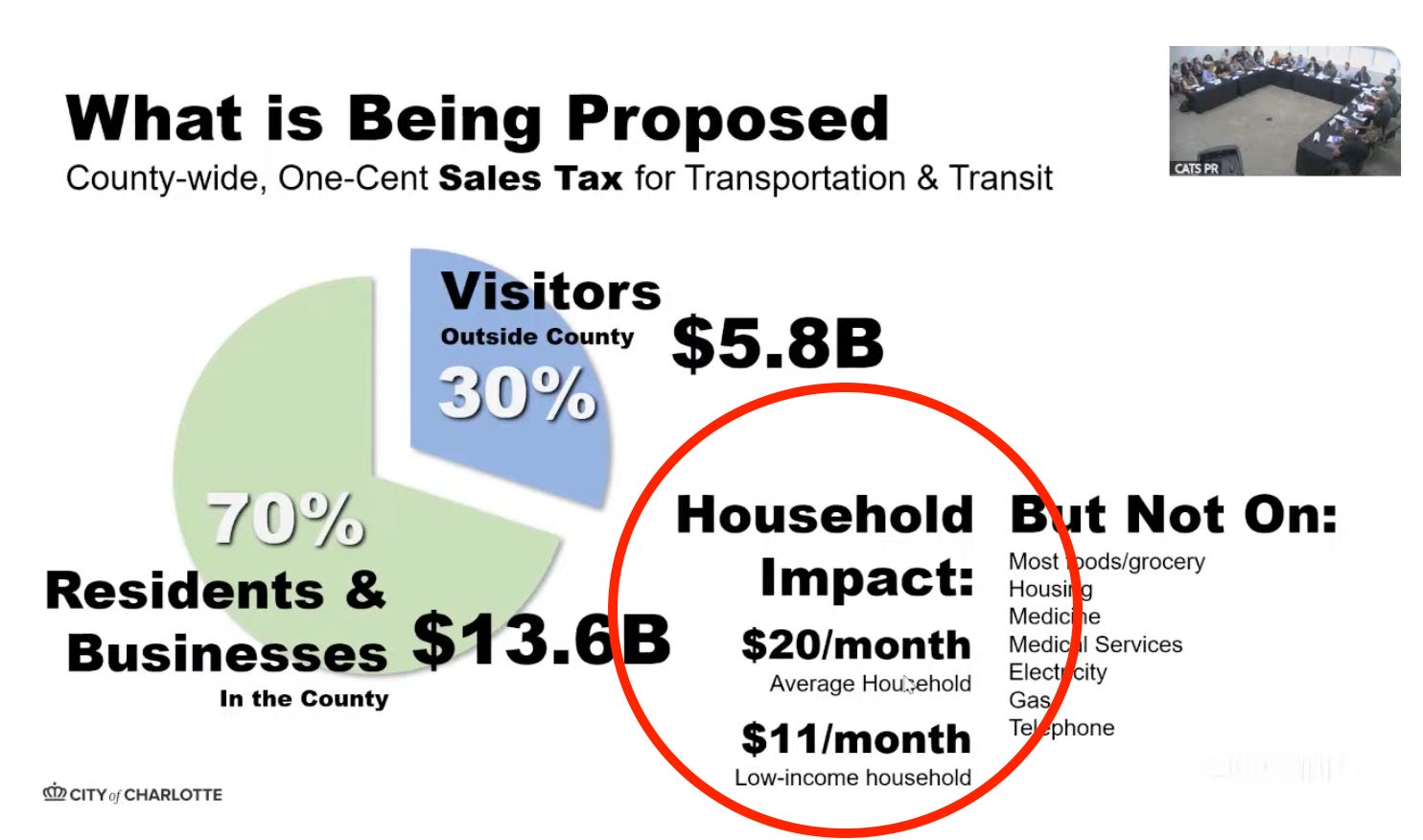
For instance, Ed McKinney, the city’s point person for the mobility plan, showed a slide in June at a Public Transit Advisory Committee meeting that gave a cost estimate. But he did not read aloud that the city estimates the increased tax would cost the average household in Mecklenburg $240 a year. The city estimates the average low-income household would pay an additional $132 a year.

A slide from a city presentation last month shows the “household impact” of a higher sales tax would be $20/month, or $240/year, for the average household. (From City of Charlotte presentation)

The town of Matthews opposes the plan because it probably won’t include money to build the Silver Line light rail to the town. Mayor John Higdon said he plans to display on the town website his estimates for the tax burden, which he puts at $290 a year for the median Mecklenburg household. For residents in his town — which is wealthier than the county overall — he estimates the tax would cost households $370 a year.

The city said its calculation comes from the federal government’s Consumer Expenditure Survey for the southeast U.S., adjusted for inflation for 2025.

Higdon said he used a different method. He took the Census Bureau’s estimate for the median household income in Mecklenburg County, which is $84,500. That’s also higher than the median household income for the southeast U.S., which is about $73,000.

An increase of 1 percentage point in the sales tax adds little to the cost of any individual purchase — it’s just 20 more cents on something that costs $20 — but over the course of a year, that additional money adds up.

Is the correct number $240 a year? $290 a year?

Impossible to say. It’s a ballpark guesstimate either way. The main point: It’s a substantial hike to local taxes.

You can try to estimate your household’s tax burden. The sales tax is applied to things like clothes, toys, electronics including TVs, restaurant and bar food and drinks, furniture and books. 

Some items are exempt, such as medicine, most groceries and cars.

The state has information about what is subject to the sales tax here.

Here are some other things to consider about the sales tax:

As a way to raise money, the sales tax has some inherent benefits

The biggest: Part of it is paid by people who don’t live in Mecklenburg County. Citing a one-page Charlotte Regional Business Alliance study, the city says 30% of the sales tax proceeds will be paid by non-Mecklenburg residents. The alliance didn’t respond to questions from WFAE and Transit Time about its methodology.

CATI's Take:

(In city's where sales taxes are higher consumers often shop elsewhere for big ticket items. In Boston for example the sales tax is only 6.25% but just across the state line in New Hampshire the sales tax is ZERO.)

It’s unclear what the exact percentage is, but clearly a significant chunk of the sales tax comes from people who don’t live here. Some people are here on business. Others are commuters. And some are people who come to Mecklenburg to shop, go out to eat and go to concerts and sporting events.

(But this requires those who live elsewhere actually buy something in Charlotte.)

Sales taxes are, however, considered regressive taxes

Wealthier households would pay more in absolute terms because they consume more. But studies have shown that sales taxes consume a greater share of a low-income families’ income than they do for wealthier households.


Sales taxes paid by businesses could also translate to higher prices

The city estimates that roughly 30% of the sales tax revenue would be generated by non-Mecklenburg residents, and about 35% will come from residents. The rest would be paid by businesses.

Some of those costs will be ultimately paid for by Mecklenburg residents, however, even if it’s not a direct item on your receipt. For instance, if you build a new deck on your house, you won’t pay sales tax on the contractor’s bill. But a contractor who buys $8,000 worth of supplies in Mecklenburg County would pay an extra $80 for the roads/transit tax. That would be passed on to the consumer.

North Carolina already charges sales tax for some home repair services, like repairing windows.

Other taxes/fees are going up

Mecklenburg County increased property taxes in fiscal year 2025 and for fiscal year 2026. The county estimates the median household will pay a combined $74 in higher property taxes for those two increases.

The city of Charlotte did not raise property taxes this year. But it did increase them last year, a hike that cost the median homeowner $49 annually.

The biggest hikes have been fees homeowners pay for garbage, storm water and water service. In fiscal year 2025, the city said those hikes would cost the median homeowner an extra $67 a year. For the upcoming fiscal year, the median homeowner will pay $90 more.

That’s a two-year tax-and-fee hike of $280. If you add the transit sales tax, that’s a two-year increase of $520.

What the tax would do

Of course, any tax increase must be weighed against the benefits it provides. The city of Charlotte and other proponents say the tax increase or roads and transit will be transformational, and that it’s critical for a fast-growing region like Charlotte.

Mecklenburg Commissioner Leigh Altman said on WFAE’s “Charlotte Talks with Mike Collins” this week that the mobility plan would help low-income workers, allowing them to get to work faster. She also said the plan will enable so-called “choice” riders to use transit by making it more convenient.

The proposed sales tax increase is expected to generate $19.4 billion over 30 years. In the first year, the tax would likely bring in about $325-330 million.

By state law, at least 40% of the money from the tax must be spent on roads or road-related projects such as sidewalks and street lights.

No more than 40% can be spent on rail transit, and 20% can be spent on other transit uses, like buses and new on-demand “micro transit.”

The road money is a windfall for Charlotte and the six Mecklenburg towns

The city has said that the sales tax would generate more than $130 million a year countywide for roads and road-related projects — money that Charlotte and the six Mecklenburg towns would be free to spend on streets, sidewalks, crosswalks, streetlights and redesigning intersections.

Charlotte’s share is estimated at $102 million for roads in the first year and $5.7 billion over 30 years. The towns get smaller amounts, but the figures still represent 10% to 20% of the towns’ budgets:

Mecklenburg’s towns and the city of Charlotte would receive millions for roads and road-related projects with the new tax. (City of Charlotte presentation)

Charlotte has a website that details potential projects. But as of now, there are no public cost estimates and no timeline for the projects that would be built in the first few years.

Charlotte envisions spending its road money all over the city, but it hasn’t released specifics and says those decisions would be made later. (City of Charlotte presentation)

There would be roughly $66 million annually for buses and micro transit

The bus mobility plan doesn’t call for many new bus routes. Instead, the focus is increasing the frequency on the 15 highest-ridership routes so buses arrive every 15 minutes, as opposed to every 20 minutes or more. All other routes would have buses arriving at least every 30 minutes.

CATS also plans to give some bus routes “signal priority” so they don’t have to stop at as many red lights.

The money would also be spent on 2,000 new bus benches and shelters.

It appears most of the money would go to expanding a new “micro transit” service that mimics Uber. CATS started this in north Mecklenburg in February and plans to add 18 additional zones.

Rail transit receives the most attention

The transit law calls for the Red Line commuter rail line to Lake Norman to be built first. After that, CATS has prioritized building the Silver Line from the airport to Bojangles Coliseum; then completing the Gold Line streetcar to the east down Central Avenue and to the west along Beatties Ford Road; and then extending the Lynx Blue Line to Pineville.

It’s an ambitious project list, and CATS said it can build and operate the trains for roughly $130 million annually in today’s dollars.

But it’s important to remember what was promised when voters chose not to repeal the existing half-cent sales tax for transit in 2007.

At the time, the Lynx Blue Line had just opened from uptown to I-485/South Boulevard. Leading up to the repeal vote, CATS pledged to voters that the half-cent sales tax would build:

  • The Blue Line extension from uptown to I-485 near Cabarrus County.

  • The streetcar through central Charlotte.

  • The Red Line to Lake Norman.

  • Bus-rapid transit from uptown to Matthews.

CATS did build the Blue Line extension — but it had to cut the line short and terminate it at UNC Charlotte to save money.

It shifted construction and operations of the streetcar to the city of Charlotte.

It didn’t have enough money to build the Red Line (which was also held up by Norfolk Southern’s ownership of the tracks), nor any sort of bus-rapid transit to Matthews.

There are many reasons. The biggest is that CATS underestimated how much it would cost to build and operate the trains.

CATS over-promised 18 years ago. Is it doing so again?

Steve Harrison is a reporter with WFAE, Charlotte’s NPR news source. Reach him at sharrison@wfae.org.